
Many parents know the timetable: maths five times a week, forty minutes a period. It feels like a lot. But the NERDC/WAEC mathematics curriculum is wide — far wider than most people realise. SS1 alone covers surds, quadratic equations, logical reasoning, mensuration, statistics, and more, often with each topic allotted roughly five lessons before the class moves on. Five forty-minute periods is 200 minutes. That is enough to introduce a topic. It is not enough for most students to interact with it enough to reach mastery — and the gap between what the curriculum expects students to know and what five lessons can actually teach is where most of the struggle lives.
The arithmetic nobody runs
Take a standard school week and count what actually happens inside those five periods:
- A typical JSS or SS timetable allocates 5 periods × 40 minutes = 200 minutes of mathematics per week — less than half the ~500 minutes the NERDC curriculum assumes for mastery
- Settling in, attendance, and board setup eat 5–10 minutes per period, so raw instructional time drops to roughly 150–175 minutes
- Of what remains, most is watching — one teacher working through problems on the board for 20-40+ students with limited chance to practise independently
- Generous estimate of true active work per week: around 150 minutes — a 350-minute gap from what the curriculum expects
- Put differently: for every 1 minute a student spends actively doing mathematics in class, the NERDC framework assumes another 2.3 minutes of engagement somewhere else — homework, group study, or guided practice at home
- This is why students who rely on classroom time alone or sparse assignments consistently underperform in WAEC and JAMB mathematics, where questions test application and fluency, not recall of worked examples
A fair question: where does the 500-minute figure come from? It is not a number printed on any single NERDC document. It is derived by taking the WAEC syllabus topic count for SS1–SS3 mathematics, estimating the practice minutes each topic needs for genuine mastery (based on the number of distinct sub-skills per topic and the typical minutes a student needs to internalise each), and summing across the three-year scheme. The exact total will vary by school and by state — some schools timetable more periods, some fewer, and term lengths differ — but the gap between what mastery requires and what a 200-minute week delivers holds across the board. The honest move for any parent reading this is to pull out their child's scheme of work, count the topics per term, and do the arithmetic themselves.
What that arithmetic reveals, topic by topic, is how thinly five periods are spread: Quadratic equations (SS1) — factorisation, completing the square, the formula, graphical solution, sum and product of roots, forming equations from given roots, and word problems.
Trigonometry and bearings (SS2) — ratios, angles of elevation and depression, sine rule, cosine rule, bearings, and 3D applications. Bearings alone defeats students who can do the trig fine, because the difficulty is diagram translation, not calculation.
Circle theorems (SS2) — eight or so theorems plus the reasoning skill of choosing which one applies. Recognition of which theorem fits an unfamiliar diagram is the entire exam skill, and it is built only by volume of exposure.
Statistics: grouped data and cumulative frequency (SS2/SS3) — class intervals, class boundaries, mean by assumed mean, histogram, ogive construction, quartiles and percentiles read off the curve, standard deviation. This is a drawing skill. You cannot acquire it watching someone else draw.
Differentiation and integration (SS3) — the entirety of introductory calculus, typically inside two to three weeks, at the exact point in the year when SS3 students are also revising five years of prior content.
Longitude and latitude (SS3) — arc length along great circles vs parallels of latitude, distance, time difference, nautical miles. Compressed into a fortnight and then rarely revisited, which is why it is a reliable free-mark question that students routinely skip.
These are a few topics that every student must master and master well. not just the best and brightest

The difference between the child who masters mathematics and the one who falls behind is rarely talent. It is minutes of active interaction – practice.
Closing the gap at home
The missing ~300-350 minutes a week is about one focused hour a day. That is the gap families have to close at home, and it does not require a lesson teacher or a second school run — just a consistent routine and the right practice material. The goal is to stack that daily hour on top of the ~200 minutes the school timetable already provides so your child hits the 500 minutes of active math work the NERDC curriculum assumes for mastery. Hour of Math(https://classspace.io/hour-of-math) is one option worth exploring; before committing, check whether its content aligns with your students specific NERDC scheme of work for their JSS or SS class and current term, and confirm what it tracks so you can measure the gap closing week by week.
How it works
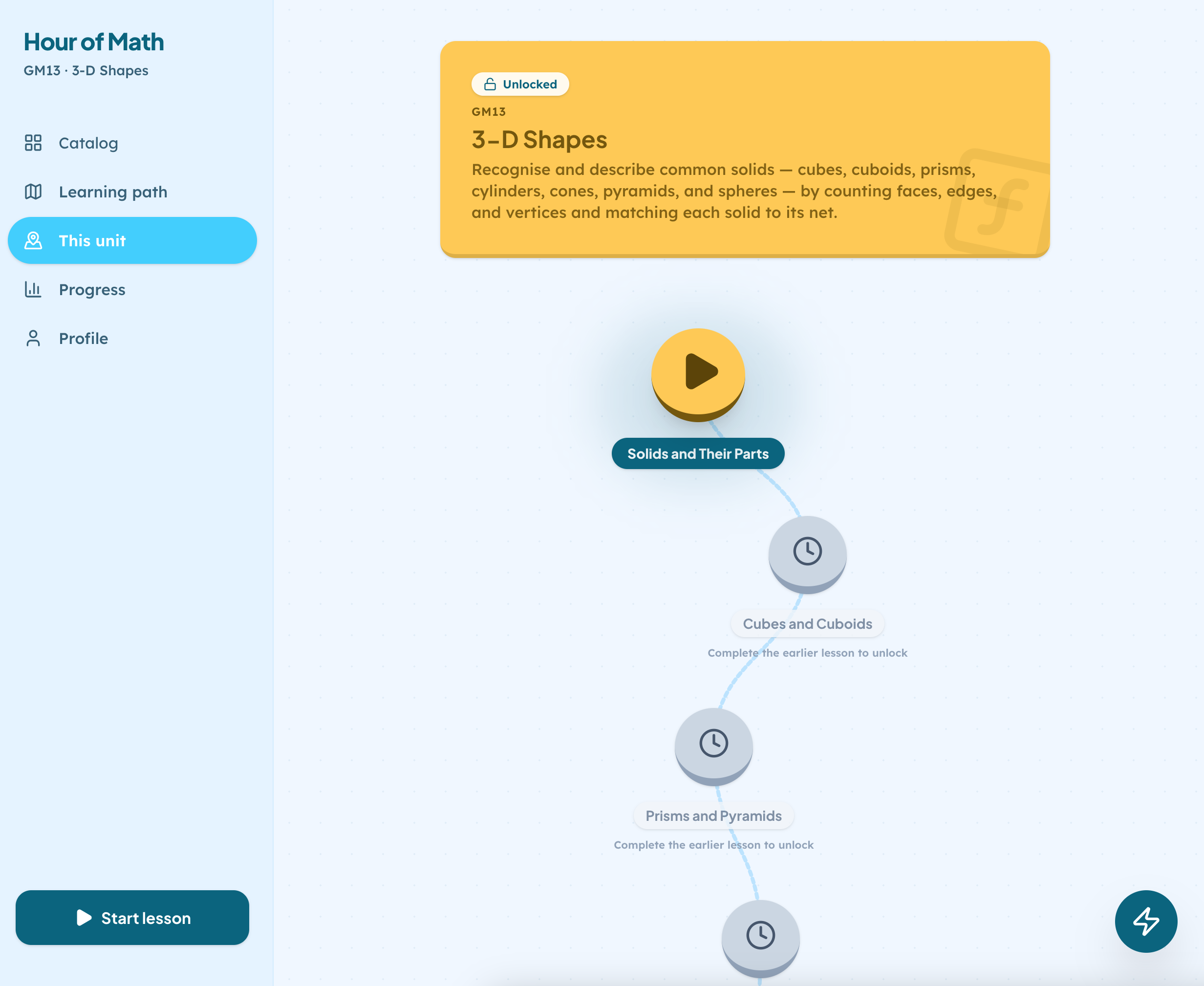
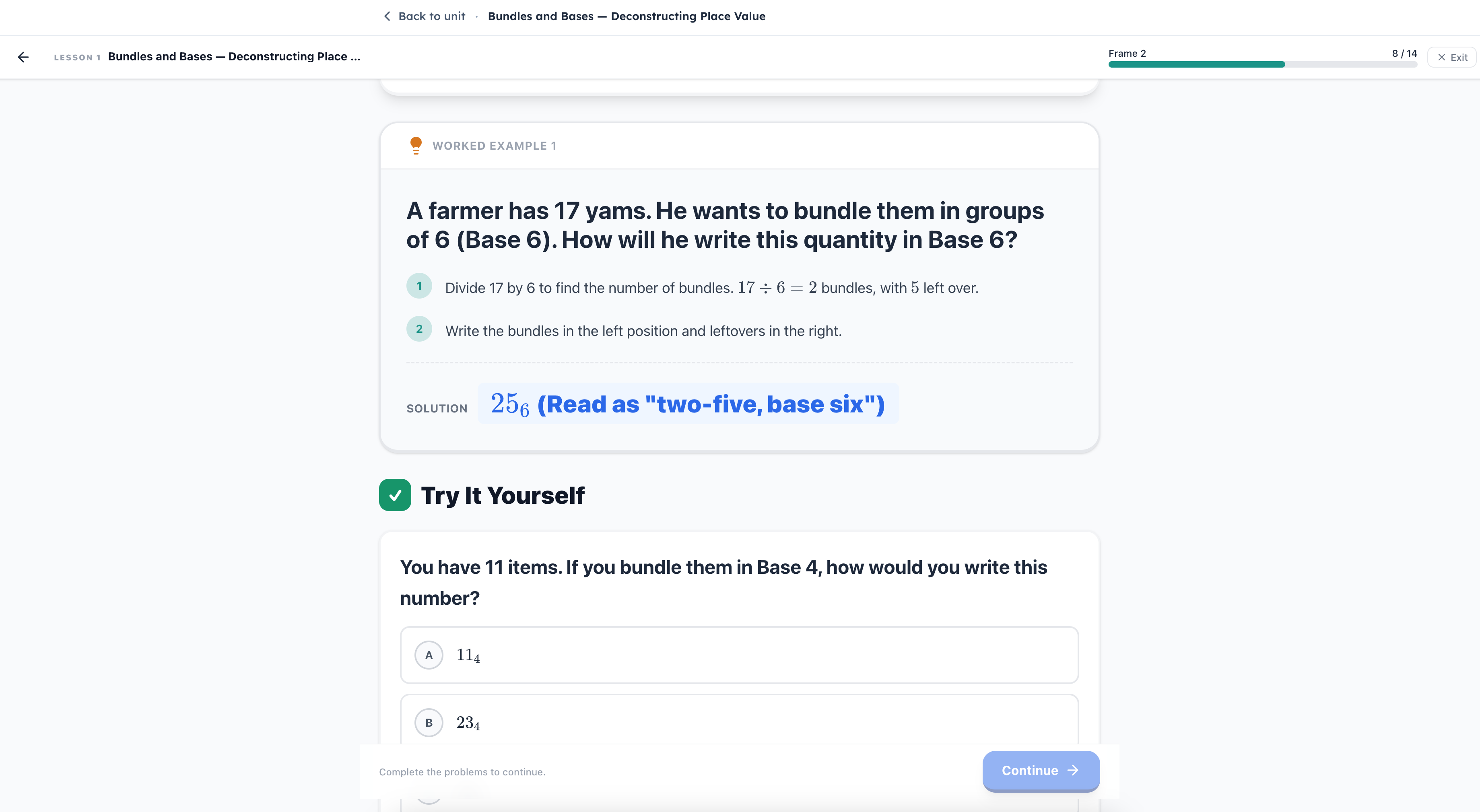
Hour of math works by using a guided instruction format which coious examples, try-its lesson practice and interleaved practice to take students gently through a lesson and a unit. the pacing is gentle but thorough and by the end of the unit a user will be able to answer exam questions.
For Schools
Hour of Math is also available directly to schools through school.classspace.io — at roughly one-sixth of the monthly family price, billed once for a full year. A school that moves 120 students onto the platform pays less in a year than two families would in a month, which is why most of our heaviest users are JSS and SS departments buying in bulk rather than parents paying out of pocket.